

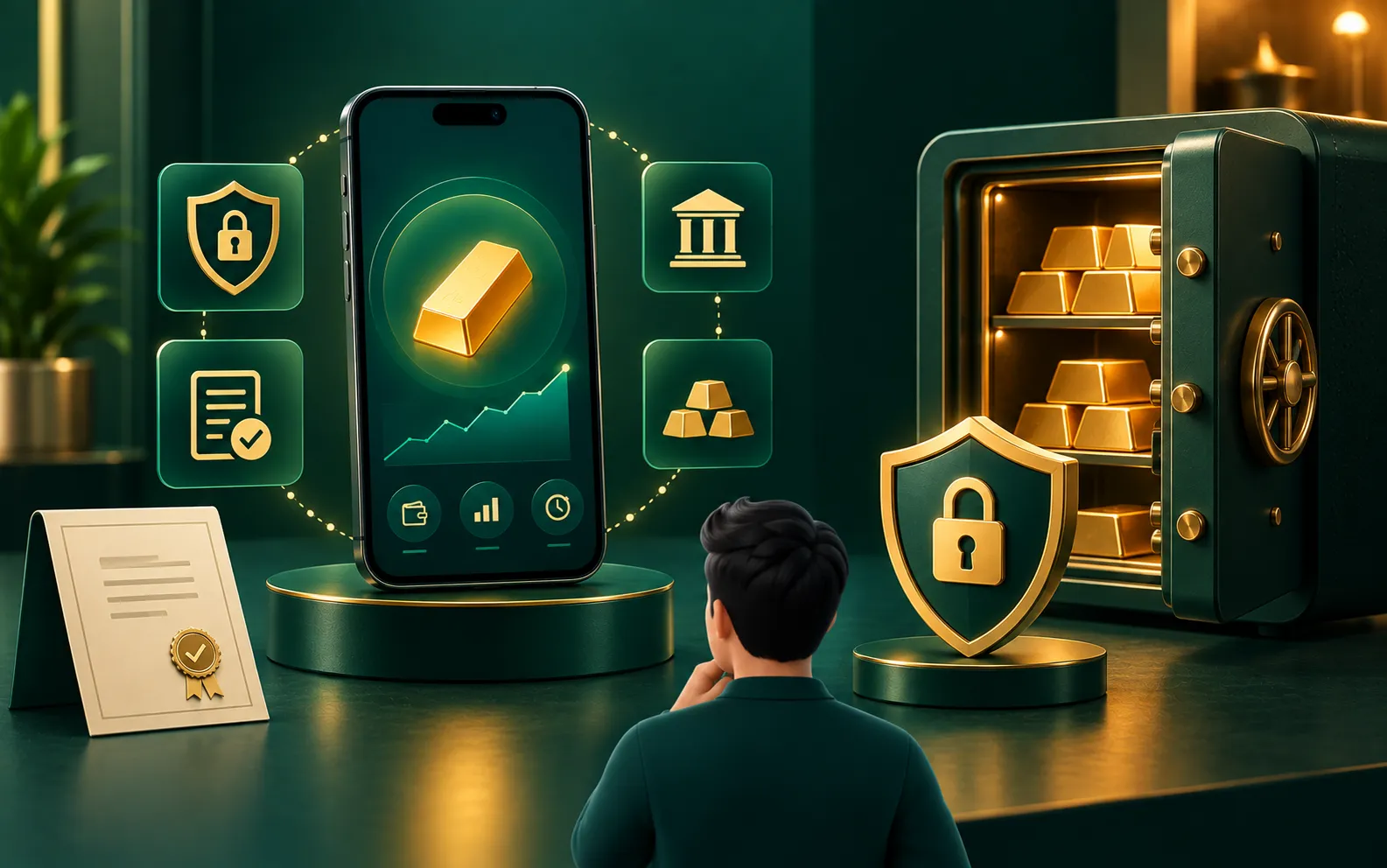
Is Digital Gold safe to buy and store? Understand how Digital Gold is stored, who holds the physical gold, how ownership works, and what you should check before buying Digital Gold in India.
When people hear about Digital Gold for the first time, one of the first questions they ask is, “Is my gold actually safe if I cannot physically see it?”
It is a reasonable question. Unlike jewellery, coins or gold bars kept at home, Digital Gold is managed through a digital platform while the underlying physical gold is held through storage and vaulting arrangements.
Understanding how Digital Gold is stored, who owns it and how the overall system works can help you make a more informed decision before you start saving.
Digital Gold can be stored through secure vaulting arrangements, but users should not assume that every Digital Gold product works in exactly the same way.
Before purchasing Digital Gold, it is important to understand who provides the gold, where the physical gold is stored, how ownership is recorded, whether the gold is insured and what happens if the platform or provider faces an operational issue.
For Sanduk, its current terms state that Digital Gold services are facilitated in association with SafeGold, which provides bullion, vaulting, fulfilment and delivery-related services. Sanduk's terms also state that purchased customer gold remains the customer's property, subject to applicable partner terms and law.
When you purchase Digital Gold, you generally do not receive a physical coin or bar at the time of purchase. The corresponding physical gold is stored through a vaulting arrangement on your behalf.
Sanduk's terms state that purchased gold may be stored with vault service providers appointed by SafeGold. SafeGold's information describes customer gold as being stored in secure vaults with arrangements covering custody and independent oversight.
This is one of the main differences between Digital Gold and physical gold that you keep at home. Instead of personally storing the gold, the physical gold is held through the provider's applicable custody and vaulting arrangements.
Ownership is an important part of understanding Digital Gold.
Buying Digital Gold does not simply mean that the app owns the gold on your behalf. According to Sanduk's current Terms & Conditions, Digital Gold purchased through the platform remains the customer's property, and Sanduk and SafeGold do not claim ownership of the customer's gold.
The exact legal structure, rights and conditions are governed by the applicable Sanduk and SafeGold terms. Therefore, users should always read the latest terms before purchasing Digital Gold.
Physical gold stored in professional vaults can have security arrangements that are different from keeping gold at home.
SafeGold states that its vaulting arrangements include secure custody and insurance, along with independent trustee oversight. Its terms also explain that insurance is subject to specific coverage conditions and exclusions.
This distinction is important because insured does not mean completely risk-free. Insurance policies can have conditions, coverage limits and exclusions. Users should review the applicable terms to understand what is and is not covered.
This is an important question to consider before buying Digital Gold.
A Digital Gold arrangement can be structured so that customer gold is separated from the platform's own operational assets. SafeGold's current consumer information states that customer gold is held separately from the company's own assets, with an independent trustee and custodian structure.
However, users should still understand the specific terms of the product they are purchasing. The safety of Digital Gold should not be judged only by the name of the app. It is important to check the actual gold provider, custody arrangement, ownership terms, insurance and redemption process.
No investment or gold-saving method should automatically be considered completely risk-free.
The price of gold can rise or fall, which means the market value of your holdings can change over time. Digital Gold can also involve platform-related risks, differences between buying and selling prices, applicable taxes and charges, storage conditions, redemption requirements and insurance exclusions.
Sanduk's terms also state that gold orders can be delayed, rejected or suspended in certain situations, including technical issues, market volatility, fraud risk or legal compliance requirements.
Therefore, the word “safe” should not be understood as meaning guaranteed returns or zero risk.
Sanduk is designed to make Digital Gold savings simple while giving users a way to track their gold digitally.
Sanduk currently facilitates Digital Gold services through SafeGold and provides features such as gold purchases, daily, weekly and monthly savings and goal-based savings.
Sanduk's privacy policy also describes security practices such as access controls, encryption for data in transit and at rest where appropriate, firewalls and restricted access to production systems.
These measures relate to platform and data security. They should not be understood as a guarantee of the future market value of gold.
Before purchasing Digital Gold, take some time to understand how the product works.
First, check who provides and fulfils the underlying gold and understand where the physical gold is stored. Read the terms explaining ownership of the gold and understand the applicable custody arrangements.
You should also check whether insurance is provided, what it covers and what exclusions apply. Understand the buying price, selling price, taxes and other applicable charges before making a purchase.
It is also important to understand the redemption process. Check whether physical delivery or other redemption options are available and what conditions or charges may apply.
Finally, read the latest Terms & Conditions of the platform and its Digital Gold provider before making a purchase. Product terms can change, so relying only on general information may not be enough.
Digital Gold can provide a convenient way to buy and save gold without keeping physical gold at home. However, understanding security, storage, ownership and risks is just as important as understanding the price of gold.
For Sanduk users, Digital Gold services are currently facilitated through SafeGold, with customer gold stored through applicable vaulting arrangements and subject to the relevant terms.
Before you start saving, instead of asking only whether Digital Gold is safe, look at the more useful questions: Who provides the gold? Where is it stored? Who owns it? How is it protected? What is insured? What are the applicable terms and conditions?
Understanding these points can help you decide whether Digital Gold fits your personal savings goals and expectations.